How Much Protein Is in Overnight Oats?
A plain jar of overnight oats, made with 150ml semi-skimmed milk, about 50g rolled oats and 1 tbsp chia seeds, has about 13g of protein in about 310 kcal. That is 17% of its energy from protein: a source of protein under UK rules, but not high protein, which starts at 20%.
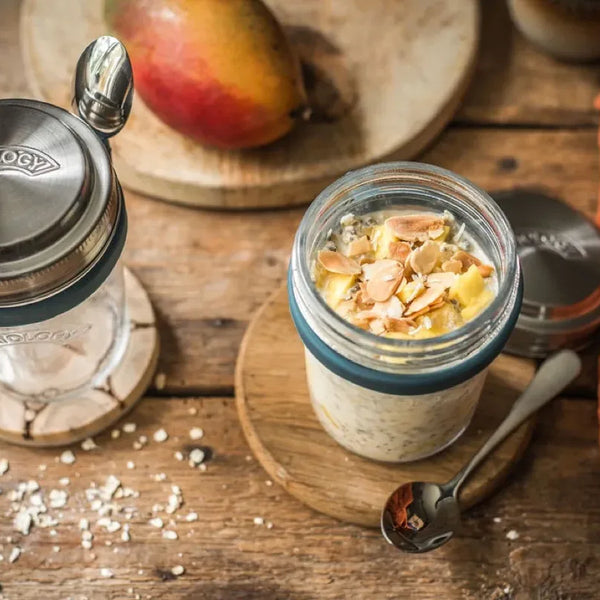
3 tbsp of natural skyr or fat-free quark takes it to about 18g, 21 to 22%: high protein, and a 30g scoop of whey or pea powder adds about 24g. The jar in the photo, our Peanut Butter Banana, is about 18g before its toppings.

How much protein is in a jar of overnight oats?
A plain jar of overnight oats has about 13g of protein. That is milk to the line (150ml semi-skimmed), one slightly heaped lid of rolled oats (about 50g) and 1 tbsp chia seeds, before any sweetener or toppings. Here is the sum, in the order it goes in, from each label's protein per 100ml or 100g.
| In the jar | Amount, at the label's protein | Protein |
|---|---|---|
| Semi-skimmed milk, to the line | 150ml, at 3.6g per 100ml | 5.4g |
| Rolled oats, one slightly heaped lid | about 50g, at 11.07g per 100g | 5.5g |
| Chia seeds | 1 tbsp (about 11g), at 20g per 100g | 2.2g |
| Total, before toppings | about 13g |
The jar is about 310 kcal, from our overnight oats calories guide: milk 75, oats 186 and chia 46. Every jar on this page uses rolled oats; for other kinds, see which oats to use for overnight oats.
Are overnight oats high in protein?
Not as a plain jar. UK rules on nutrition claims judge protein as a share of a food's energy: a food is a source of protein when protein gives at least 12% of its kcal, and high protein from 20%.
A plain jar with semi-skimmed milk is about 13g of protein in about 310 kcal, so protein gives 17% of its energy. It is a source of protein, but not high protein.
Grams alone do not settle it. With 20g of hemp seeds stirred in, the jar has about 20g of protein, but at about 420 kcal that is 19%, short of the line. The table further down shows which jars reach 20%.
How much protein is in overnight oats with different milks?
Each row is a whole jar: 150ml of that milk or drink, one slightly heaped lid of oats (about 50g) and 1 tbsp chia seeds, before toppings.
| Milk to the line (150ml): its protein | The jar (about) | Energy from protein |
|---|---|---|
| Semi-skimmed milk: 5.4g | 13g in 310 kcal | 17%, a source of protein |
| Whole milk: 5.3g | 13g in 330 kcal | 16%, a source of protein |
| Skimmed milk: 5.4g | 13g in 280 kcal | 18%, a source of protein |
| Oat drink, not barista: 0.8g | 8g in 300 kcal | 11%, not a source of protein |
| Unsweetened almond drink: 0.8g | 9g in 250 kcal | 13%, a source of protein |
| Unsweetened soya drink: 5.0g | 13g in 280 kcal | 18%, a source of protein |
| Coconut drink, from a carton: 0.3g | 8g in 270 kcal | about 12%, depends on the carton |
| Water: 0g | 8g in 230 kcal | 13%, a source of protein |
The share is protein against kcal. Oat drink brings 71 kcal and 0.8g of protein to the jar, so the jar comes to 11%. Water brings neither, so a water jar is 13%. Coconut drinks vary by carton: the ones we checked read 0.1g to 1.2g of protein per 100ml.
Another brand? Take the protein per 100ml from the carton and multiply it by 1.5 for the 150ml line. For other amounts and batches, see our overnight oats ratio guide.
Why do gym-goers make overnight oats?
For anyone who trains, it comes down to time and numbers.
- Ready in the fridge. Train before work? Make the jar the night before and breakfast is already in the fridge.
- The same measures every time. Our overnight oats jar has both measures built in: the line on the back marks 150ml of milk, and one slightly heaped lid holds about 50g of oats. The same start each night means the same numbers to log: about 13g of protein and about 310 kcal with semi-skimmed milk.
- Protein in grams. Every add-in on this page is listed by the gram, with its kcal, so you can set the jar to your own number.
- Batch a few jars. Fill several in one go. For how long each kind keeps, see how long overnight oats last.
- Into the bag. With the sealing lid on, the jar goes in your bag.
- No cooking. It is eaten cold, straight from the jar.
How do you make high protein overnight oats?
High protein means protein gives at least 20% of the jar's kcal, so what counts is protein for its kcal, not grams alone. Each row is the plain semi-skimmed jar (about 13g of protein, about 310 kcal) with one change. Yoghurt and seeds go in with the chia; powder goes into the milk first. Spoons are level 15ml tablespoons.
| Add-in, and what it adds | The jar (about) | Energy from protein |
|---|---|---|
| Natural skyr, 3 tbsp, about 45g: adds 4.5g protein, 27 kcal | 18g in 330 kcal | 21%, high protein |
| Quark, fat free, 3 tbsp, about 45g: adds 5.0g protein, 28 kcal | 18g in 330 kcal | 22%, high protein |
| Strained Greek yoghurt, 3 tbsp, about 45g: adds 4.0g protein, 43 kcal | 17g in 350 kcal | below 20% |
| Greek-style yoghurt, full fat, 3 tbsp, about 45g: adds 1.8g protein, 52 kcal | 15g in 360 kcal | 17%, not high protein |
| Whey protein powder, a 30g scoop, before the splash of milk: adds 24.2g protein, 116 kcal | 37g in 420 kcal | 35%, high protein |
| Pea protein powder, a 30g scoop, before the splash of milk: adds 24.0g protein, 116 kcal | 37g in 420 kcal | 35%, high protein |
| Milk labelled high protein (5.5g protein, 56 kcal per 100ml), to the line instead of semi-skimmed: 8.3g protein, 84 kcal | 16g in 320 kcal | 20% |
| Smooth peanut butter, 1 tbsp, about 15g: adds 3.9g protein, 89 kcal | 17g in 400 kcal | 17%, not high protein |
| Hemp seeds, shelled, 20g: adds 6.6g protein, 117 kcal | 20g in 420 kcal | 19%, not high protein |
| Pumpkin seeds, 20g: adds 4.9g protein, 116 kcal | 18g in 420 kcal | 17%, not high protein |
Two jars, strained Greek yoghurt and a milk labelled high protein, land between 19.5% and 20.5%, too close to the line to call, so we give their numbers and no label. Peanut butter, pumpkin seeds and full-fat Greek-style yoghurt get 14 to 18% of their own kcal from protein, so they add grams but the jar does not reach 20%.
Greek-style yoghurt is not strained Greek yoghurt, so read the label. The full-fat Greek-style pots we checked read about 4.1g of protein per 100g, strained Greek about 8.8g, the skyrs, all labelled high protein, about 10g, and fat-free quark about 11.1g.
Without protein powder: pour semi-skimmed milk to the line, then stir 3 tbsp of natural skyr or fat-free quark in with the chia. That is about 18g of protein in about 330 kcal, 21 to 22%, high protein with no powder at all. With a milk labelled high protein to the line instead of semi-skimmed, it is about 20 to 21g in about 340 kcal, 24%. Yoghurt sets the jar thicker, so loosen it with a splash of milk in the morning if you like.
Semi-skimmed milk to the line, one slightly heaped lid of oats and 1 tbsp chia: about 13g of protein in about 310 kcal, 17%. Stir in 3 tbsp of natural skyr or fat-free quark and it is about 18g in about 330 kcal, 21 to 22%: high protein.
How do you add protein powder to overnight oats?
Stir the powder into the milk first, then add the oats and chia. A loose scoop takes up about 60 to 100ml before it dissolves, so tipped in on top of the oats it could sit above the jar's thread.
- Milk to the line, then a splash. Pour milk to the line (150ml), then a further 30 to 50ml, about 2 to 3 tbsp, for each scoop. That is the range given in guides to cooking with protein powder.
- Stir until smooth. Stir the powder into the milk until no lumps are left. Then add one slightly heaped lid of oats (about 50g) and 1 tbsp chia, stir right to the bottom, seal and chill overnight.
- Use a milkshake-style powder. Clear whey is made to mix with water, and UK sports nutrition brands advise against mixing it with milk. Use an ordinary whey or plant powder, the kind made for milkshakes.
- Read your tub. Protein per 100g on the label, times your scoop in grams, divided by 100. At 80g per 100g, a 30g scoop is 80 x 30 / 100 = 24g. Work out the kcal the same way. Scoops on UK tubs run from about 20g to 33g.
- What the jar comes to. With 30 to 50ml of semi-skimmed on top of the line, a 30g scoop of whey or pea powder makes about 38 to 39g of protein in about 440 to 450 kcal, 35%.
- With yoghurt as well. 3 tbsp of skyr can stand in for the splash of milk: with a 30g scoop of whey or pea powder, the jar is about 42g of protein in about 450 kcal, 37%.
- Eat it within 2 days. Protein brands give overnight oats made with powder 2 to 3 days in the fridge, and we keep to the shorter end.
How much protein is in our overnight oats recipes?
Each figure is our estimate for the recipe made as written, on the same basis as our calories guide: semi-skimmed milk (coconut drink in Mango and Coconut), honey where a recipe offers honey or maple syrup (1 tbsp where it says 1 to 2 tbsp), chia counted where a recipe marks it optional, and the same toppings left out.
| Recipe | The jar (about) | Energy from protein |
|---|---|---|
| How to Make Overnight Oats, our basic recipe | 13g in 380 kcal | 14% |
| Apple Pie | 15g in 390 kcal | 15% |
| Banana Bread | 18g in 520 kcal | 14% |
| Blended Berry | 15g in 420 kcal | 15% |
| Blueberry and Lemon | 15g in 430 kcal | 14% |
| Chocolate and Raspberry | 17g in 440 kcal | 15% |
| Mango and Coconut | 9g in 360 kcal | 10% |
| Peanut Butter Banana | 18g in 490 kcal | 15% |
| Strawberry Cheesecake | 14g in 440 kcal | 13% |
Before toppings, eight of the nine get 13 to 15% of their kcal from protein, and Mango and Coconut, made with coconut drink, 10%. None reaches the 20% line as written.
How did we work these numbers out?
- UK labels. Each ingredient's protein is the median of UK supermarket and brand labels checked on 4 November 2026, multiplied by the amount in the jar; lemon zest uses a USDA figure, and spices, salt and water count as 0. The kcal for the plain jar, the milks, peanut butter and our recipes are the figures in our calories guide; other add-ins use the 4 November label medians.
- Share of energy. Protein in grams times 4 kcal, divided by the jar's kcal, worked from unrounded figures. For the plain jar, 13.13g x 4 = 52.5 kcal of its 306.5 kcal, which is 17%. UK rules allow "source of protein" from 12% and "high protein" from 20%. Where a jar lands between 19.5% and 20.5%, we give the numbers and no label.
- Greek yoghurt. In our recipes, Greek yoghurt is counted as strained Greek yoghurt: 8.8g of protein and 96 kcal per 100g, the kcal our recipes already use. Greek-style yoghurt is a different product, with its own row in the add-in table.
- Rounded at the end. Jar protein to the nearest gram, single ingredients to 0.1g, shares to the nearest whole per cent and jar kcal to the nearest 10, so adding rounded figures can land a gram or a few kcal away from a total: oat drink and almond drink both show 0.8g in 150ml, but their jars work out at 8.48g and 8.56g, so one rounds to 8g and the other to 9g. The strained Greek yoghurt jar works out at 19.6%, so we show it as below 20%. The coconut drink jar works out at 11.9% with our median of 0.2g per 100ml and 12.5% at 0.5g, so we give its numbers and no label.
- Estimates. One slightly heaped lid is about 50g, and labels differ by brand: the unsweetened soya drinks we checked ran from 2.8g to 3.4g of protein per 100ml, and whey powders from about 76g to 82g per 100g. Your own labels give your own figure.
- Toppings. The plain jar, milk and add-in figures count none. The recipe figures leave out the same toppings as our calories guide.
Your questions
How many calories are in overnight oats with protein powder?
About 420 kcal for a plain semi-skimmed jar with a 30g scoop of whey or pea powder, which adds about 116 kcal. With the 30 to 50ml of milk we add for the scoop, it is about 440 to 450 kcal. Labels vary, so check your tub.
How much protein is in overnight oats with Greek yoghurt?
It depends on the yoghurt. 3 tbsp (about 45g) of strained Greek yoghurt adds about 4.0g, so a plain semi-skimmed jar comes to about 17g of protein in about 350 kcal. The same amount of full-fat Greek-style yoghurt adds about 1.8g. Four of our recipes use 1 tbsp of Greek yoghurt, about 1.3g, and Banana Bread uses 60g, about 5.3g.
Can you make protein overnight oats without yoghurt?
Yes. A plain jar made with semi-skimmed milk is a source of protein without it: about 13g in about 310 kcal, 17%. For high protein with no yoghurt, stir a 30g scoop of whey or pea powder into the milk with a 30 to 50ml splash of semi-skimmed: about 38 to 39g in about 440 to 450 kcal, 35%. With no powder either, fill to the line with a milk labelled high protein (about 5.5g of protein per 100ml) and add 20g of shelled hemp seeds: about 23g in about 430 kcal, 21%.
Keep reading
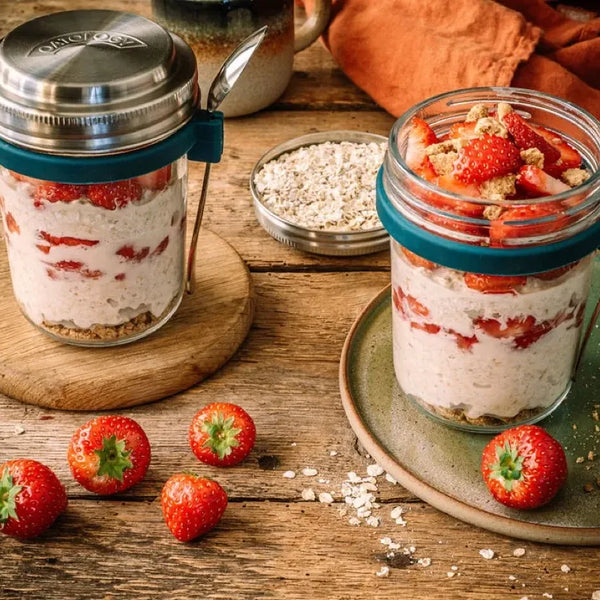
Strawberry Cheesecake Overnight Oats
Cream cheese, strawberries, and a biscuit crunch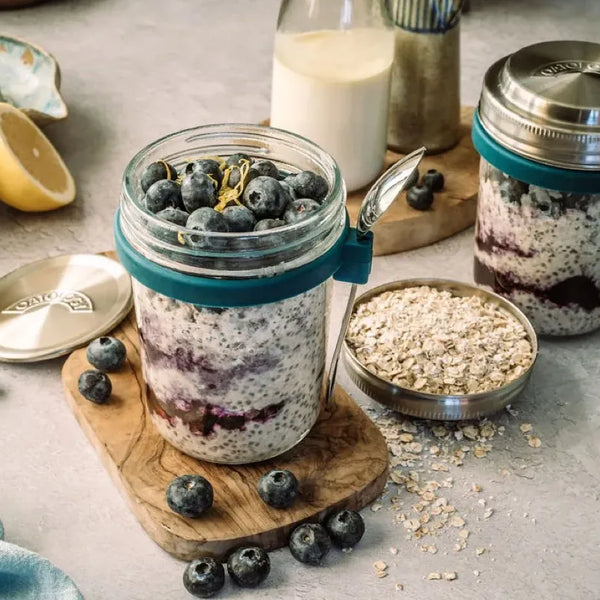
Blueberry and Lemon Overnight Oats
Lemon zest and blueberries, bright and fresh
Blended Berry Overnight Oats
Blended smooth, with no oaty bits to chew